 45057b6fb7
|
||
|---|---|---|
| .. | ||
| challenge/procedural | ||
| final/procedural | ||
| projects | ||
| resources | ||
| starter/procedural | ||
| README.md | ||
| animoji.webp | ||
| morphing.png | ||
| references.markdown | ||


README.md
Chapter 13: Instancing & Procedural Generation
As I read this book, I summarize what I think is wrong. If you think my comments are wrong then please let me know. We can dicuss more and update your opinion.
Morphing
Morphing which is explaned by this book isn't the cannonical way of morphing. Morphing is usually a morphable mesh where primitives’ attributes are obtained by adding the original attributes to a weighted sum of targets attributes.
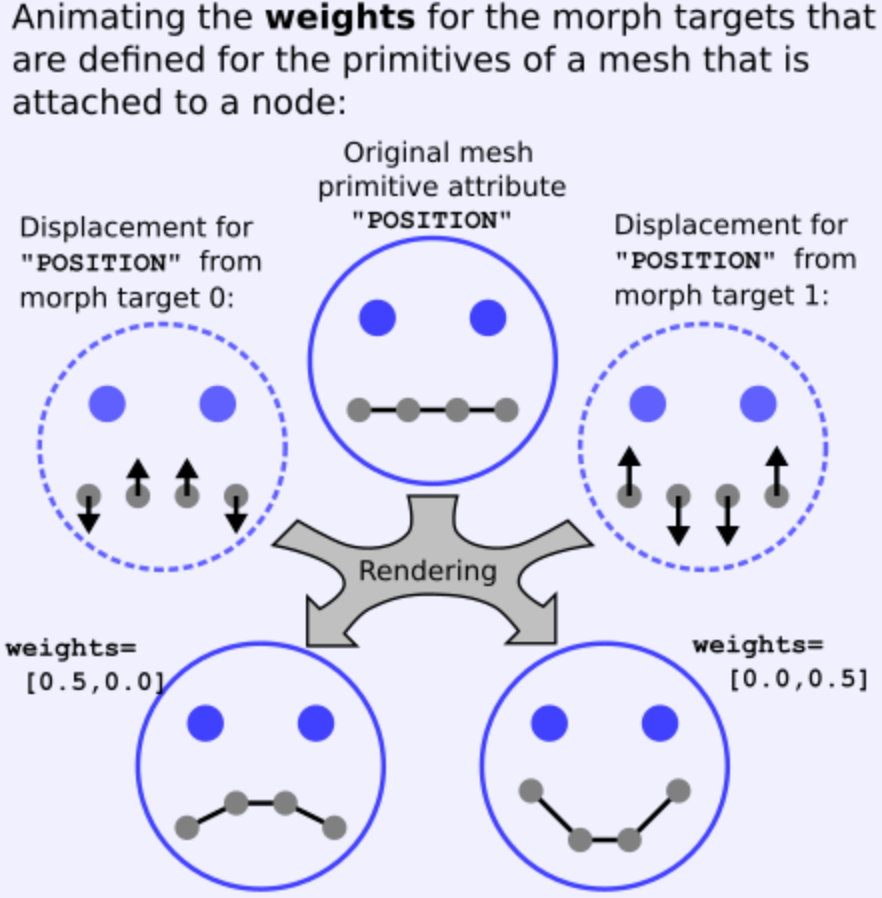
For instance, the the position of vertices for the primitive at index i are computed in this way:
primitives[i].attributes.POSITION +
  weights[0] * primitives[i].targets[0].POSITION +
  weights[1] * primitives[i].targets[1].POSITION +
  weights[2] * primitives[i].targets[2].POSITION + ...

Apple's animoji is the most famous example of morphing.
Miscalculation of the world position
In Nature.metal and Houses.metal, the world position is calculated incorrectly, replace:
out.worldPosition = (uniforms.modelMatrix * vertexIn.position
                        * instance.modelMatrix).xyz;
With:
out.worldPosition = (uniforms.modelMatrix * instance.modelMatrix
                        * vertexIn.position).xyz;
The result isn't changed because the world position is not used anywhere.